VerseDash is made for finding a verse fast. When you want to dig deeper, it’s there: tap Words on any verse to see the original Greek or Hebrew behind each English word.
Tap Words. The verse shows with each word underlined that has a Greek or Hebrew word behind it.
Tap any underlined word.
Then you see:
original word, Greek for the New Testament, Hebrew for the Old,
meaning, short and plain,
Strong’s number, like G166 (more about these below),
where it comes from, the older word it was made from,
how to say it, with a button that reads it aloud,
and the other verses that use the same word, the best-known first.
Prefer to see the Greek or Hebrew words themselves, in their own order? Tap Show the Greek words (or Show the Hebrew words) in the same window.
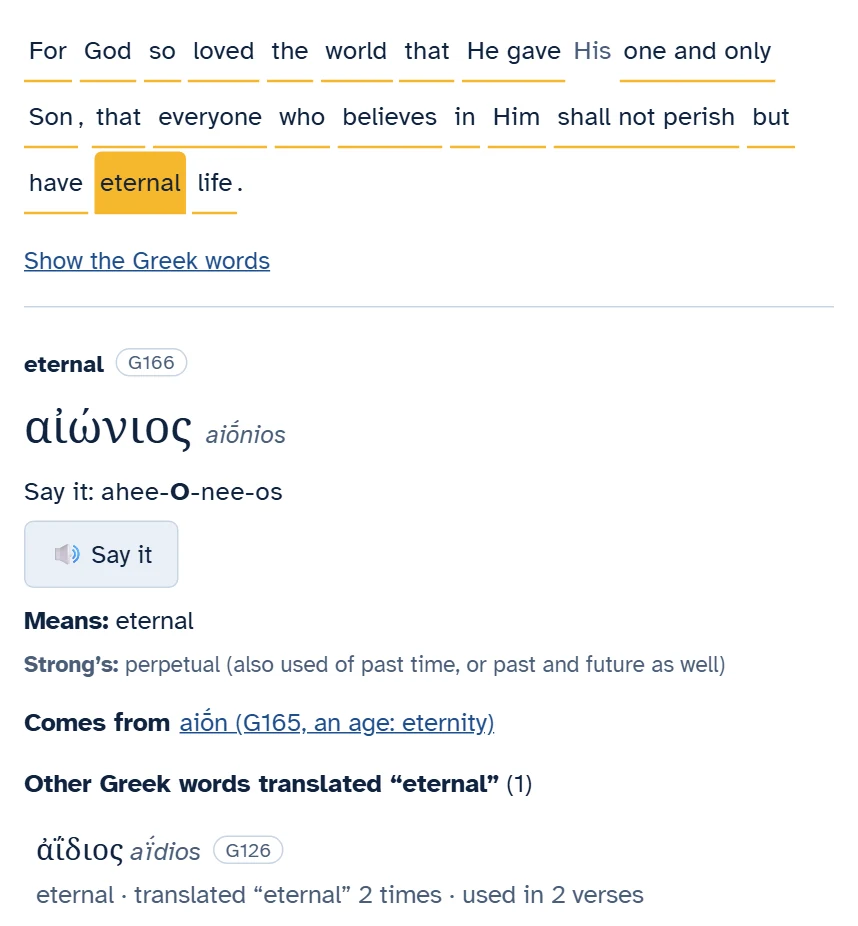
The Words window in VerseDash, with “eternal” tapped in John 3:16.
A Greek example: John 3:16
The New Testament was written in Greek. Here is John 3:16 as the Words window shows it, word for word.
John 3:16 (BSB)
27 English words · 25 Greek words · 3 English phrases come from one Greek word each · 1 English word has no Greek word behind it
The English words
ForGodsolovedtheworldthatHe gaveHisone and onlySon, thateveryonewhobelievesinHimshall not perishbuthaveeternallife.
The Greek words, in their own order
ΟὕτωςsoG3779γὰρForG1063ἠγάπησενlovedG25ὁ—G3588ΘεὸςGodG2316τὸνtheG3588κόσμονworldG2889ὥστεthatG5620τὸνhisG3588ΥἱὸνSonG5207τὸν—G3588μονογενῆone and onlyG3439ἔδωκενgaveG1325ἵναthatG2443πᾶςeveryoneG3956ὁwhoG3588πιστεύωνbelievesG4100εἰςinG1519αὐτὸνHimG846μὴ—G3361ἀπόληταιperishG622ἀλλ’butG235ἔχῃhaveG2192ζωὴνlifeG2222αἰώνιονeternalG166
eternalG166
αἰώνιοςaiṓnios
Say it: ahee-O-nee-os
(modern pronunciation)
Means: eternal
Strong’s: perpetual (also used of past time, or past and future as well)
Comes fromaiṓn (G165, an age: eternity)
Used in 68 verses
The same Greek word, translated: eternal (65), began (2), ages past (1), give eternal (1), good (1)
In John 3:16 the BSB translates aiṓnios as “eternal.” It does so 65 times in all.
Three English words, one Greek word
Sometimes a whole English phrase comes from a single Greek word. In John 3:16, “one and only” is one word: monogenḗs. VerseDash underlines the phrase once, so one tap shows it.
ForGodsolovedtheworldthatHe gaveHisone and onlySon, thateveryonewhobelievesinHimshall not perishbuthaveeternallife.
one and onlyG3439
μονογενήςmonogenḗs
Say it: mon-og-en-ACE
(modern pronunciation)
Means: unique
Strong’s: only-born, i.e. sole
Comes frommónos (G3441, alone) and gínomai (G1096, to be)
Used in 9 verses
The same Greek word, translated: one and only (3), one and only Son (3), only (2), only child (1)
A Hebrew example: Genesis 1:1
The Old Testament was written in Hebrew, which reads from right to left. So the first Hebrew word of the Bible is on the right.
Genesis 1:1 (BSB)
10 English words · 7 Hebrew words · 3 English phrases come from one Hebrew word each
The English words
In the beginningGodcreatedthe heavensandthe earth.
Strong’s: gods in the ordinary sense; but specifically used (in the plural thus, especially with the article) of the supreme God; occasionally applied by way of deference to…
Comes from: plural of ʼĕlôwahh (H433, god)
Used in 2,247 verses
The same Hebrew word, translated: God (2,249), gods (192), God’s (17), He (7), both God (4), and 72 more
“In the beginning” is one Hebrew word too, the first word of the Bible: בְּרֵאשִׁית. It is rêʼshîyth (H7225, first: beginning; say it: ray-SHEETH) with “in” joined to its front.
Hear it
Every word has Say it: a simple respelling like ahee-O-nee-os, with the stressed part in capitals, and a button that reads it aloud. These respellings come from Strong’s own dictionaries.
The voice is your own device’s, the one it already uses to read aloud. Nothing is sent anywhere, so it works offline too.
If your device has a Greek or Hebrew voice, a second button, Greek voice or Hebrew voice, reads the word itself. That voice speaks today’s Greek or Hebrew, so it’s marked “modern pronunciation.”
Try the Say it buttons in the examples above. If your browser can’t speak, the buttons stay hidden and the respelling is still there.
How to install Greek and Hebrew voices
Most phones, tablets and computers can speak Greek and Hebrew, free; the voice just has to be installed once. Then the Greek voice and Hebrew voice buttons show up here and in VerseDash.
Your deviceOther devices
Windows
Microsoft Edge usually needs nothing: it has its own online voices, including Greek and Hebrew. Try the buttons above in Edge first.
For Chrome, Firefox and other browsers, the voice must be added in Windows itself (adding Greek to the browser’s language list isn’t enough): open Settings, then Time & language, then Speech.
Under Manage voices, choose Add voices, tick Greek and Hebrew, and choose Add. Wait until they show under Installed voice packages.
Close and reopen your browser, then come back to this page.
If every voice package shows 0 MB and nothing installs, Windows can’t download them on this computer; use Edge instead.
A thorough, step-by-step Windows tutorial with pictures will be here by 17 January 2027.
Android
Open Settings, then System, then Languages (on Samsung phones: General management).
Choose Text-to-speech output, then the gear beside Speech Recognition & Synthesis from Google.
Choose Install voice data, then download Greek and Hebrew.
Come back to this page; the buttons appear once the voices are installed.
iPhone, iPad and Mac
iPhone or iPad: open Settings, then Accessibility, then Spoken Content, then Voices.
Choose Greek and tap the download arrow beside a voice (for example Melina); do the same for Hebrew (for example Carmit).
Mac: open System Settings, then Accessibility, then Spoken Content. Beside System voice, choose Manage Voices, then tick a Greek and a Hebrew voice.
Close and reopen your browser, then come back to this page.
Linux
Install the free eSpeak NG voices, which include Greek and Hebrew. On Ubuntu, Mint or Debian, in a terminal: sudo apt install espeak-ng speech-dispatcher-espeak-ng.
Firefox uses them right away after a restart. Chrome needs to be started with --enable-speech-dispatcher.
eSpeak's voices sound robotic, but they say the words clearly.
On a Chromebook: Settings, then Accessibility, then Text-to-speech, then Speech engine settings; add Greek and Hebrew.
These voices speak today’s Greek and Israeli Hebrew. Churches and seminaries often teach a different, older-style pronunciation of Biblical Greek, which is what the respellings follow.
What Strong’s numbers are
In 1890, James Strong published a concordance of the King James Bible that gave every Hebrew and Greek word a number. H numbers are Hebrew words and G numbers are Greek words.
The same number always means the same original word, even when the English changes. For example, kósmos (G2889) is usually “world,” and ʼĕlôhîym (H430) is “God” 2,249 times and “gods” 192 times. Following a number shows you every place the Bible uses that word.
VerseDash’s word list has 8,539 Hebrew and 5,337 Greek words.
Good to know
It follows the Berean Standard Bible (BSB). The BSB’s translators published tables that line up each English word with the Greek or Hebrew word behind it, and Words uses those tables. In another Bible, Words shows the same verse in the BSB’s wording, marked “(BSB wording),” so every word lines up.
Not every English word has one behind it. 95.4% of the BSB’s words do. The rest are mostly small words the translators added so the sentence reads well in English.
The meanings are short. Each is a brief gloss, a few words, plus Strong’s own short definition. It’s a doorway into a word, not a full dictionary.
The pronunciations are a guide. No one today knows exactly how Biblical Greek and Hebrew sounded.
The extra books of Catholic Bibles (like Tobit and Sirach) don’t have Words yet.
Try it
Words is in VerseDash now, free. Look up John 3:16, tap the verse, then tap Words.
Words (Strong’s numbers): Berean Standard Bible tags, public domain (berean.bible). Short meanings from STEP Bible, Tyndale House Cambridge, licensed CC BY 4.0, STEPBible.github.io/STEPBible-Data (short meanings selected: most frequent sense). Strong’s Hebrew Dictionary from the Open Scriptures Hebrew Bible Project, licensed CC BY 4.0, github.com/openscriptures/HebrewLexicon. Strong’s Greek Dictionary (1890), public domain.
Changes to STEP Bible’s data: where STEP gives a word more than one sense, VerseDash keeps the one used most often (“short meanings selected: most frequent sense”).